

Gold: China's Master Move
Updated: Sep 25

While the financial world keeps its eyes fixed on Wall Street and the swings of the dollar, Beijing is quietly executing one of the boldest economic manoeuvres of this century. China has not only become the planet's largest gold producer, it has sealed its borders so that not a single ounce leaves its territory, all while silently devouring the world's inventories of the precious metal.
What does the Asian giant know that the rest of the world doesn't? Discover the 4 pillars on which China has built its master move, designed to dethrone the dollar, rewrite the rules of real money, and redefine its own financial sovereignty.
Pillar # 1: The World's Largest Gold Producer
China has cemented its position as the number-one gold producer in the world. In 2025, it extracted more than 381 tonnes of gold from its soil, accounting for roughly 10% of global gold output and far outpacing historical rivals such as Australia, Russia, and the United States. This capacity gives the country a substantial domestic source of gold at a time when the metal has taken on greater strategic importance.
Pillar # 2: Exports Banned
The colossal amount of gold mined in China never reaches the vaults of other countries. By law, the People's Bank of China (PBOC) strictly prohibits the commercial export of gold produced within its borders. National regulations require mining companies to channel 100% of their output to the State or through the Shanghai Gold Exchange (SGE). By locking down this legal circuit, Beijing ensures that not one of those 381-plus annual tonnes leaves the country, turning its mining industry into a purely internal liquidity shield.
Pillar # 3: An Insatiable Buyer
Despite not selling a single ounce abroad, China's appetite for the yellow metal is so vast that it has simultaneously become the world's largest gold buyer. In 2025, its domestic demand exceeded 950 tonnes (against the 381 tonnes it produced), leaving a deficit of nearly 600 tonnes, which it imported en masse from financial hubs such as London and Switzerland. Something else significant happened, too: demand for bars and coins—that is, investment gold—rose 35% to 504 tonnes, surpassing jewelry consumption for the first time.
Pillar # 4: Darkness and Secrecy
The mystery surrounding China's strategy deepens because of its lack of transparency. Historically, the Beijing government has resorted to under-reporting its purchases on international markets. While customs authorities around the world record massive gold shipments bound for Chinese ports, the PBOC's official reserve balances tend to move at a trickle, reporting discreet monthly additions (often just 2 tonnes) and keeping its official holdings at a total of 2,346 tonnes. Various financial analysis firms, such as Société Générale, estimate that real off-the-books purchases could be as much as 10 times the declared figures, allowing China to amass enormous strategic reserves without alerting the markets.
CHINA'S OFFICIAL GOLD RESERVES
2017 – 2026 (June)
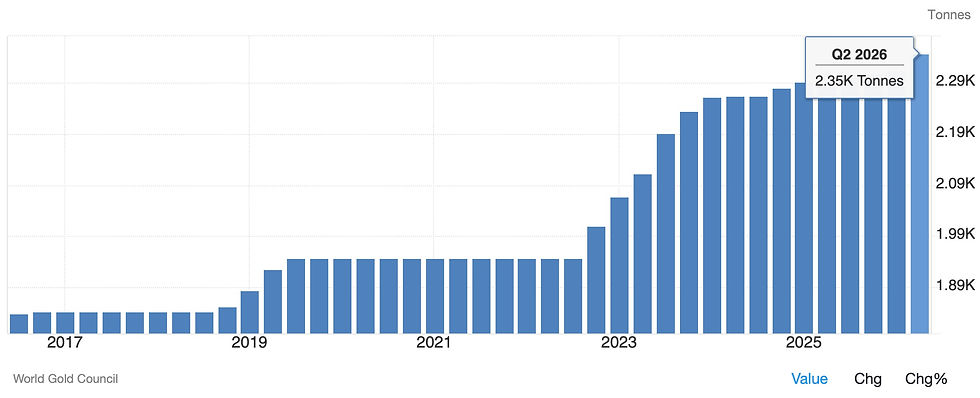
Source: Trading Economics
Latest News: The Aggressive Buying Spree of 2026
This quiet strategy, built on the 4 pillars described above, reached peak intensity during the first half of 2026. Apparently driven by fears over geopolitical tensions and the urgency to diversify its assets away from the US dollar's sphere of influence, China's buying flow surged.
Over the first six months of the year, Chinese gold imports jumped a staggering 89%, bringing in a record 865 tonnes of foreign gold (versus 457 tonnes in the same period a year earlier). At the same time, the PBOC kept growing its official gold reserves, formally adding 40 tonnes during the first half of 2026.
How Far Does China Want to Go?
Behind this strategy appears to lie a colossal goal. A report by BMO Capital Markets reveals that at China's current pace of accumulation, its real gold reserves could surpass those of the United States within the next five years, pointing to a target of 18,000 tonnes.
While there is no evidence that this is an official target, analysts believe China's growing gold hoard could help strengthen the international credibility of its currency and expand the country's influence in the global gold market. In other words, Beijing may be seeking to shift pricing power away from the traditional Western hubs and strengthen its global monetary clout.
Should You Follow in the Giant's Footsteps?
China's master move leaves a powerful lesson for any investor: real money isn't paper, it's the tangible asset. If the world's second-largest economy, with access to privileged resources and information, decides to lock down its domestic production, import massively, and conceal its reserves to shield itself from geopolitical instability, the average citizen should take notice.
Beijing's behavior shows that gold remains the ultimate safe haven for protection. And in a scenario where the great powers are competing to accumulate physical metal and dethrone the dollar, owning gold is not just a preservation strategy, it is the surest way to guarantee personal financial sovereignty.
Protect your Savings
Aktagold helps individuals worldwide protect their wealth from economic instability by providing access to savings in physical gold, stored in high-security vaults at the Royal Canadian Mint® in Ottawa (Canada), offering a level of protection once reserved for the wealthiest investors.

